
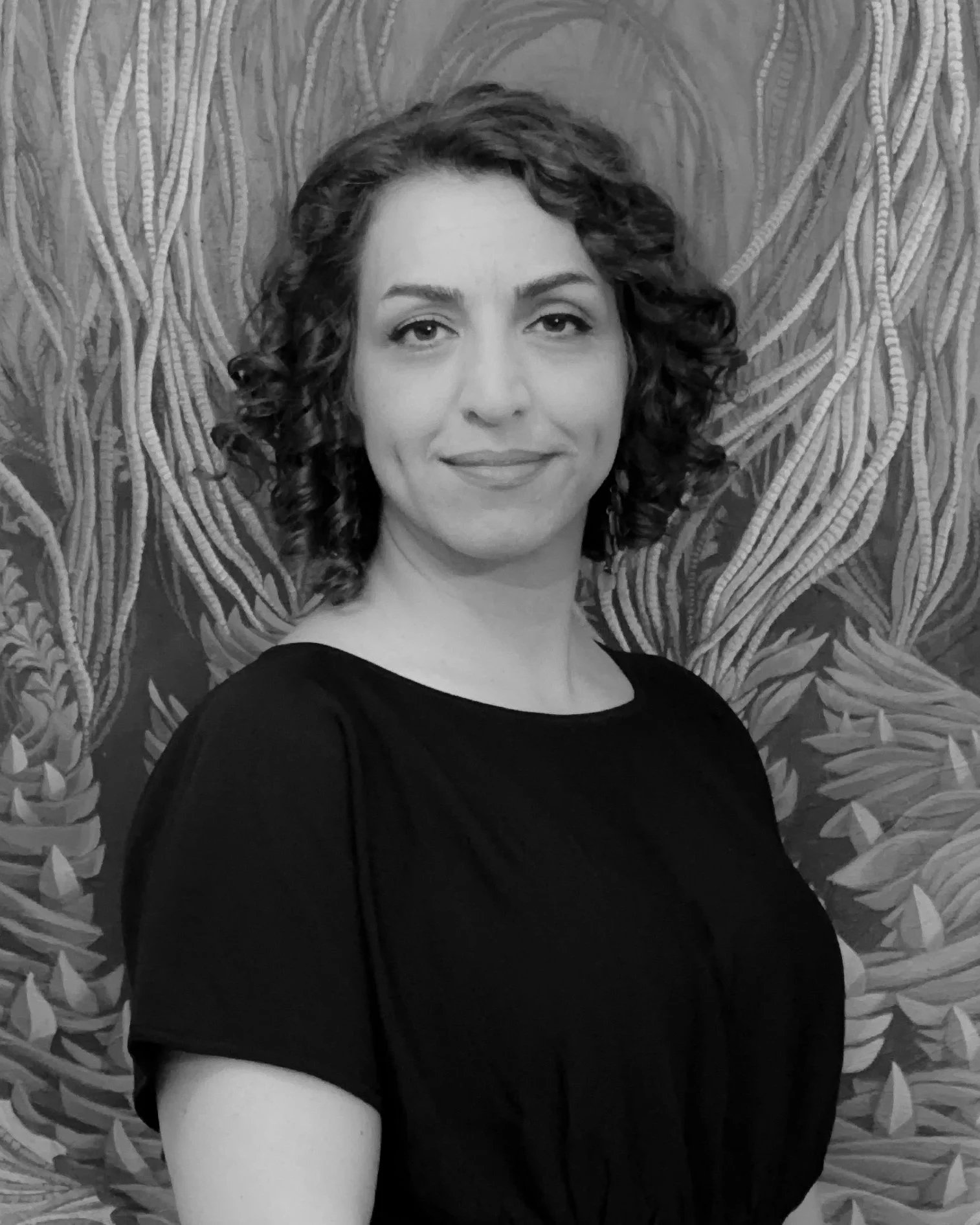
Mahboubeh Goudarzi
Mahboubeh (Mona) Goudarzi's artistic practice explores transformation as an ongoing process rather than a final state. Inspired by the adaptive intelligence of nature, she creates imagined forms that exist between the botanical, biological, and human. Their branching structures, vines, roots, leaves, and evolving forms become visual expressions of the inner landscapes people carry—their emotions, memories, vulnerabilities, and capacity for renewal.
Her work considers the ways living beings reshape themselves in response to pressure, uncertainty, and the environments they inhabit. In nature, growth emerges through continual negotiation with surrounding conditions: trees bend toward light when confronted by obstacles, roots redirect themselves around stone, and organisms gradually alter their forms to survive and regenerate. These adaptive processes become metaphors for the ways people navigate change, reorganize themselves through lived experience, and continue to grow despite hardship. Rather than presenting identity as fixed or complete, her work suggests that it is continually shaped through relationships, memory, vulnerability, and resilience.
The imagined forms that inhabit Goudarzi's paintings and drawings exist in a state of continuous becoming. They branch outward, intertwine, fracture, regenerate, and evolve, resisting stable definitions while revealing the interconnectedness of inner experience and the natural world. Organic elements are not literal representations of plants or organisms, but symbolic structures through which emotional states, personal transformation, and the resilience of the human spirit become visible.
The process of making is equally central to the work. Through the gradual accumulation of layered brushstrokes, repeated marks, and intricate textures, each composition develops much like a natural system. Forms emerge slowly, responding to one another as they expand across the surface, allowing each painting to evolve organically rather than toward a predetermined outcome. This process reflects the rhythms of growth found in nature, where transformation unfolds through continual adjustment rather than sudden change.
Drawing from the adaptive strategies of plants and living organisms, Goudarzi's work reflects on transformation as a necessary condition of existence. Her imagined ecosystems consider how growth emerges through instability, how resilience develops through vulnerability, and how change unfolds through continual processes of formation, adaptation, and renewal. By blurring the boundaries between human and natural forms, her work invites viewers to reflect on the ways individuals continually reshape themselves in response to the forces, relationships, andenvironments that shape their lives.
About the Artist
Mahboubeh (Mona) Goudarzi is a Vancouver-based painter whose practice explores transformation, adaptation, and the interconnectedness of human experience and the natural world. Drawing inspiration from the adaptive intelligence of nature, she creates imagined forms that merge botanical, biological, and human elements, using symbolism to examine resilience, emotional growth, and continual becoming.
Her artistic practice delves into the complexities of human emotion and the psyche, moving beyond literal representation to create intricate visual worlds where organic structures become metaphors for inner experience. Branches, vines, roots, leaves, and hybrid organisms emerge as symbolic forms that reflect the ways individuals navigate uncertainty, vulnerability, and change. Through layered mark-making and intuitive processes, her paintings evolve organically, mirroring the adaptive rhythms found in nature and revealing the continual negotiation between inner and outer worlds.
Goudarzi holds a Bachelor of Fine Arts in Painting from the Art University of Tehran and is a member of the Society of Iranian Painters (SIP). Since 2023, she has been an active member of the Orange Easel Group in British Columbia. Her work has been exhibited in Iran and Canada, including the Tehran Museum of Contemporary Art, Haft Samar Gallery, Baran Gallery, Khane Naghsh Isfahan, and Zameen Art House. Now practicing independently in Vancouver, she continues to create works that invite contemplation of the fluid, ever-changing nature of identity, resilience, and the human condition.
The Garden that Remembers, 2026
$4000
Birth of a Garden, 2026
$8500